Why 60% of Users Disable Push Notifications (And How to Fix It)
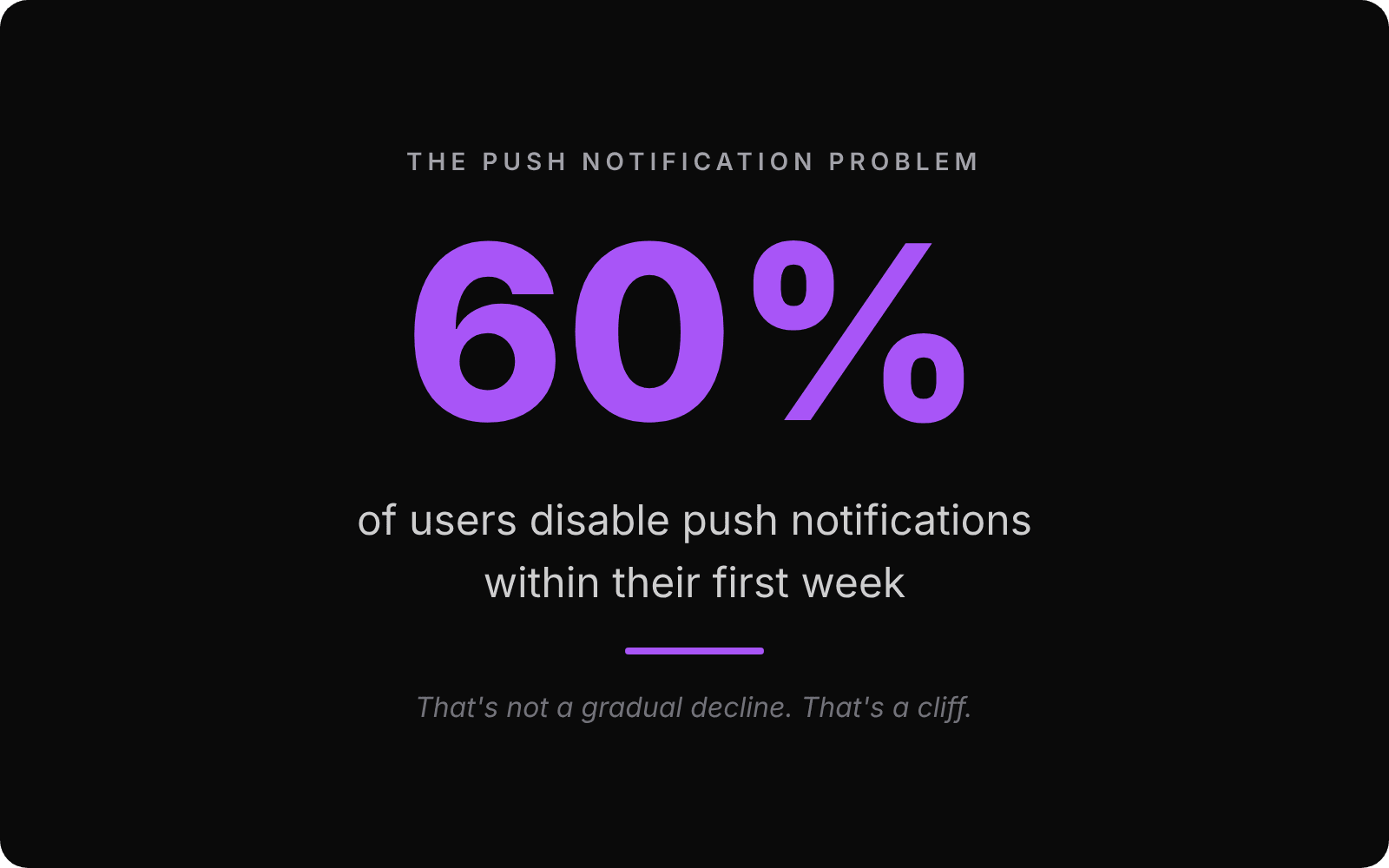
Here's a stat that should make every app developer uncomfortable: 60% of users disable push notifications within the first weekof installing an app. That's not a gradual decline. That's a cliff.
According to the Airship Push Notification Benchmark Report, the average app loses more than half its push-reachable audience before it even has a chance to prove value. And the apps that survive this window? Most of them are still sending the kind of notifications that make users reach for the “off” switch.
The question isn't whether push notifications work. They do — apps with effective push strategies see 3–10x higher retention than those without. The question is: why do most apps get push so wrong?
The Three Root Causes
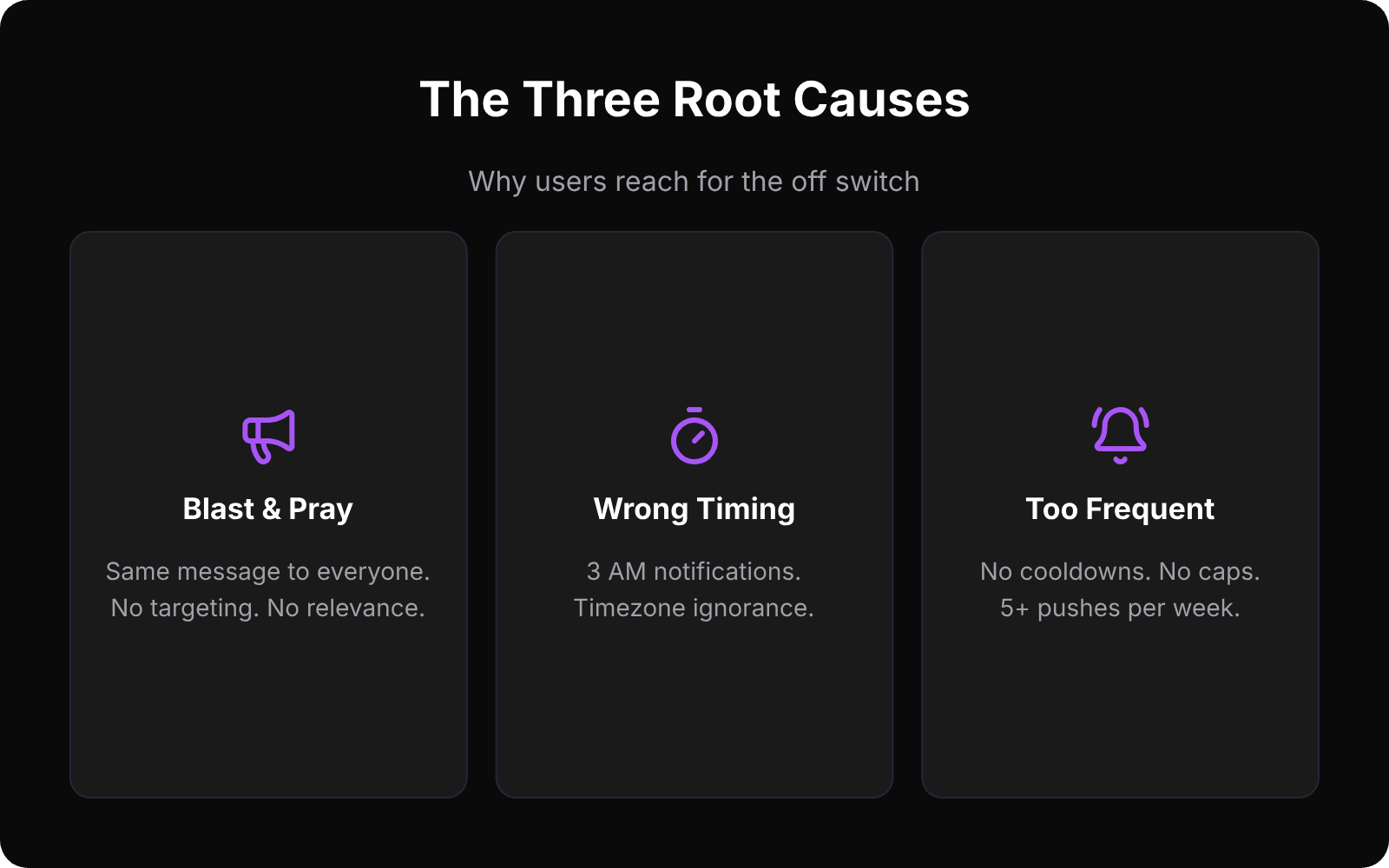
1. The Blast-and-Pray Problem
The most common push strategy is also the worst: send the same message to every user, hope someone engages. This approach treats push notifications like email blasts, ignoring the fundamental difference — push is intrusive. It interrupts whatever the user is doing. That interruption needs to be worth it.
When a user receives a push about a feature they've never used, a sale on a category they don't care about, or a “We miss you!” message 12 hours after their last session, the message is clear: this app doesn't know me. The rational response is to disable notifications.
2. The Timing Problem
A notification at the wrong time isn't just ignored — it's actively harmful. A gaming app sending push at 3 AM. An e-commerce app interrupting a meeting. A fitness app reminding you to work out while you're at work.
Most push platforms let you schedule by your timezone, not the user's. So your “9 AM motivation” message arrives at 2 AM for users in a different continent. The fix isn't just timezone-aware scheduling — it's behavior-aware timing. Send the message when the user is most likely to act on it, based on their actual usage patterns.
3. The Frequency Problem
There's a threshold for every user: the point where push notifications transition from helpful to annoying. For most users, that threshold is surprisingly low — 2–5 notifications per week, depending on the app category.
Without proper frequency controls, it's easy to cross that line. A user triggers three different campaigns in one day, each sending a notification. By day two, they're in Settings, turning you off.
What the Data Says Works
Apps that maintain high push opt-in rates share three characteristics:
- Behavior-driven triggers. Notifications fire in response to what the user actually did (or didn't do), not on a calendar schedule. Abandoned cart? Relevant. Haven't opened in 3 days? Timely. Weekly digest on Tuesday at 10 AM regardless of behavior? Ignorable.
- Personalized content. The message references something specific to the user: their name, their last action, their progress, their preferences. Generic copy gets generic results (which is to say: the unsubscribe button).
- Built-in frequency controls. Cooldown periods between messages, per-user caps, and message rotation ensure no single user gets overwhelmed. The best push strategies feel like a thoughtful friend, not a desperate marketer.
The Localization Gap
There's a fourth factor that's often overlooked: language. CSA Research found that 72% of users prefer content in their own language. If your app has users in 20 countries but you're sending English-only push notifications, you're effectively ignoring the majority of your audience.
This isn't just a “nice to have.” Non-English push open rates are typically 2–5% for English-only messages vs. 10–15% for localized messages. That's a 3–5x difference from a change that requires zero new features — just translated copy.
Fixing the Problem: A Framework
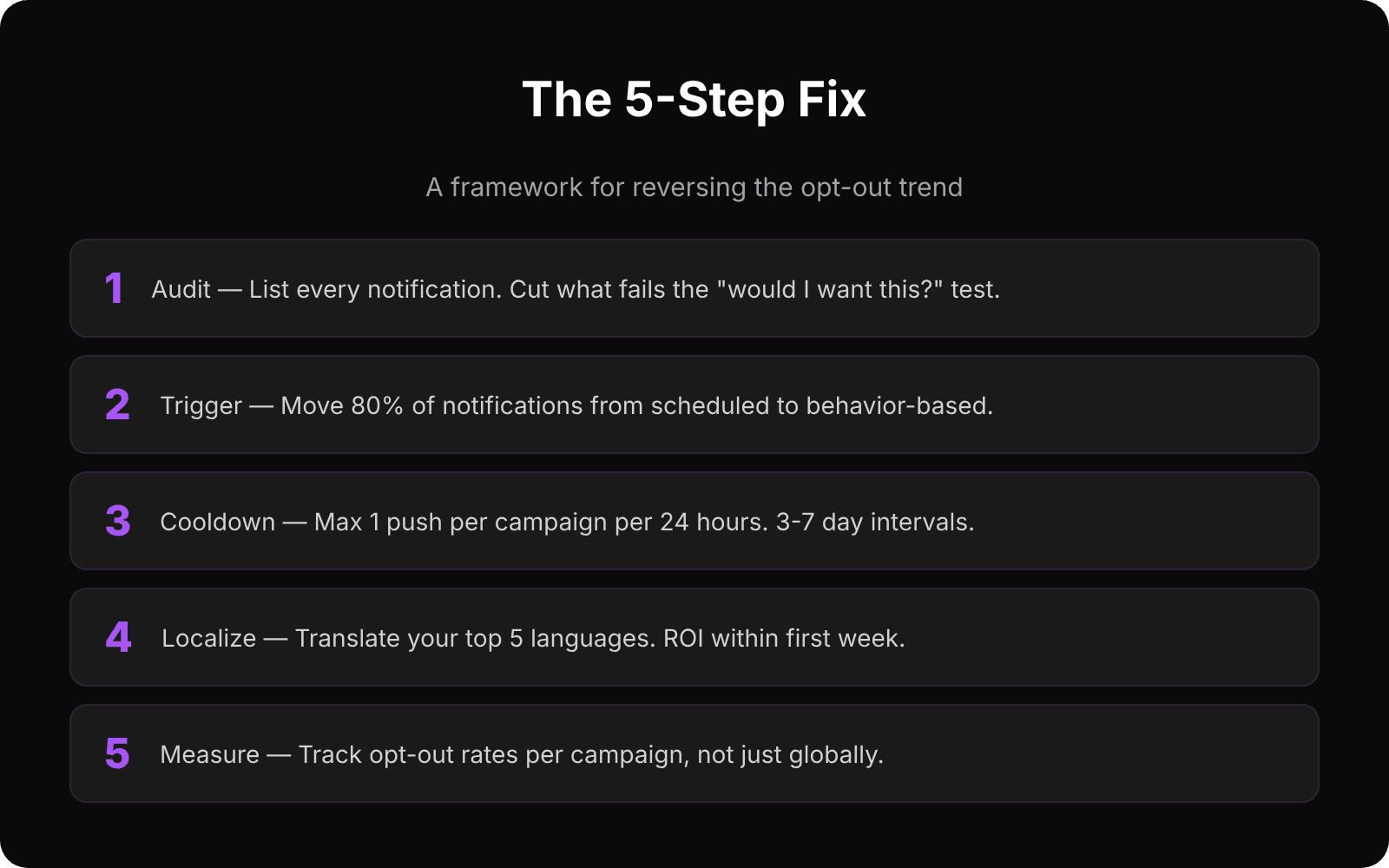
Here's a practical framework for reversing the 60% opt-out trend:
- Audit your current pushes. List every notification your app sends. For each one, ask: “Would I want to receive this?” Be honest. Cut anything that doesn't pass the test.
- Move from scheduled to triggered. Convert at least 80% of your notifications from time-based to behavior-based. The event that triggers the push should be the reason the user cares about the message.
- Add cooldowns everywhere. No user should receive more than one push from the same campaign within 24 hours. Period. Most campaigns should have 3–7 day cooldowns.
- Localize your top 5 languages. Check your analytics for the top 5 user languages. Translate your push messages into those languages. The ROI on this effort is almost always positive within the first week.
- Measure and iterate. Track opt-out rates per campaign, not just globally. If one campaign has a high opt-out rate, it's the campaign that's broken, not push notifications as a channel.
The Bottom Line
Push notifications aren't broken. The way most apps use them is. The 60% opt-out rate isn't inevitable — it's the result of generic, poorly-timed, over-frequent messages that users rightfully reject.
The apps winning at push are the ones treating notifications as a personalized, behavior-driven communication channel— not a broadcast megaphone. The technology to do this exists. The question is whether you'll implement it before your users hit the off switch.
Ready to send smarter push notifications?
Build smarter engagement with SmartAppPush.
Get Started Free