7 Push Notification Anti-Patterns That Are Killing Your App's Engagement
Push notifications are one of the most powerful re-engagement tools available to mobile apps. They're also one of the most abused. The gap between “helpful notification” and “reason to uninstall” is narrower than most teams realize.
Here are seven anti-patterns we see repeatedly — and the specific fixes that turn push from an annoyance into an asset.
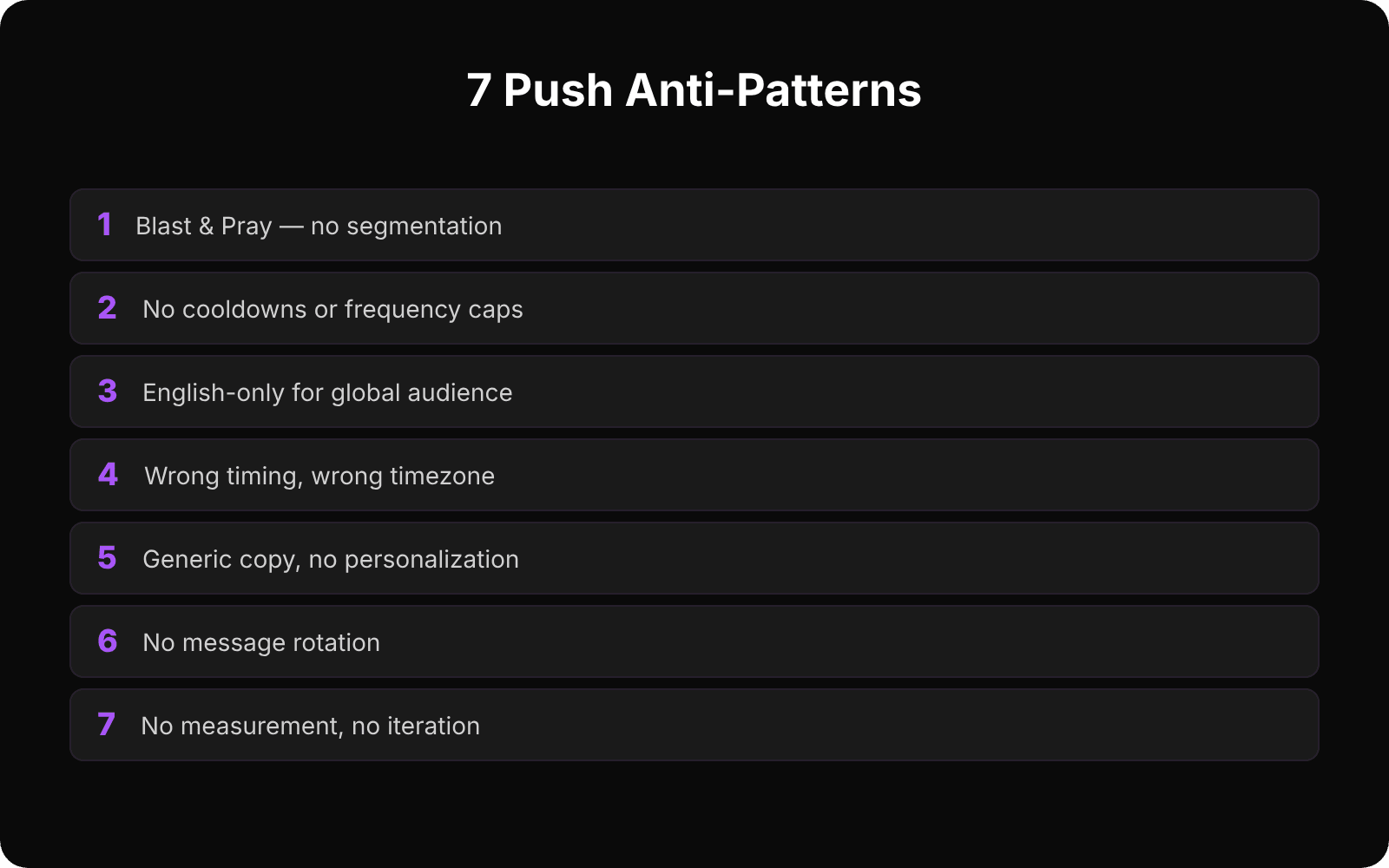
1. Blast and Pray
The anti-pattern: Send the same message to your entire user base. No segmentation, no targeting, no personalization. One message, everyone gets it, and you hope for the best.
Why it kills engagement:A user who just made a purchase doesn't need a “Come back!” message. A user who has never visited a specific feature doesn't care about updates to that feature. Irrelevant messages train users to ignore — or disable — all your notifications.
The fix: Segment your audience based on behavior. At minimum, separate active users, at-risk users, and lapsed users. Each group should receive different messages with different goals. Even basic segmentation by last-active date dramatically improves open rates.
2. No Cooldowns or Frequency Caps
The anti-pattern:A user triggers three different campaigns in one day and receives three separate push notifications. By the second day, they're in Settings disabling your app.
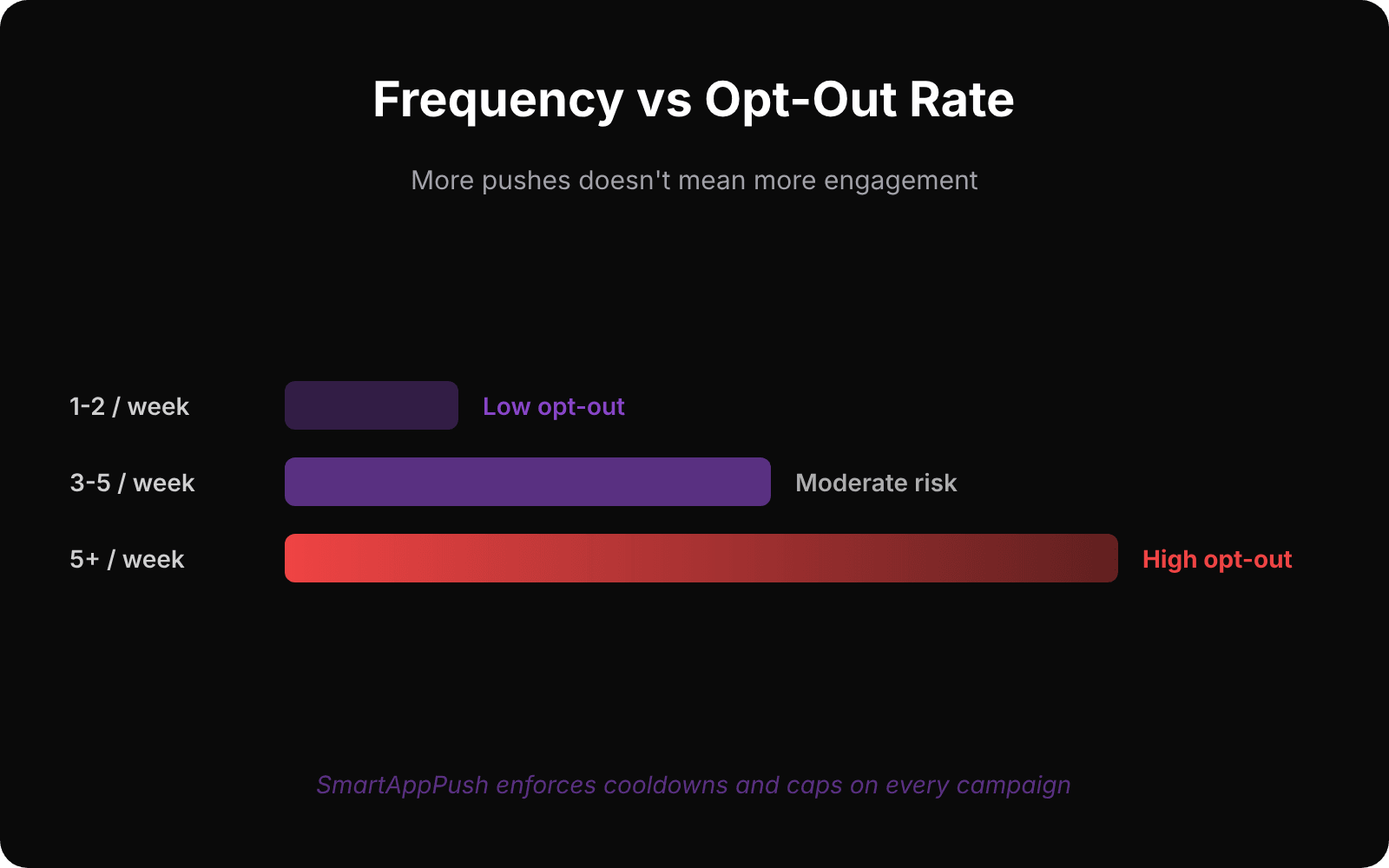
Why it kills engagement:Notification fatigue is real and it's fast. Research shows that users who receive more than 5 pushes per week from a single app have significantly higher opt-out rates. The damage is hard to reverse — once a user disables push, they rarely re-enable it.
The fix:Implement per-campaign cooldowns (minimum 24 hours between sends from the same campaign) and global frequency caps (maximum 1–2 pushes per day across all campaigns). The user who doesn't receive today's notification is still reachable tomorrow. The user who disables push is extremely difficult to win back.
3. English-Only for a Global Audience
The anti-pattern:Your app has users in 20+ countries, but every push notification is in English. You tell yourself “most people understand English” and move on.
Why it kills engagement:Open rates for English-only pushes in non-English markets are typically 2–5%. Localized pushes see 10–15%. You're getting a fraction of possible engagement from the majority of your user base.
The fix:Identify your top 5 user languages from analytics. Translate your highest-impact campaigns (cart abandonment, re-engagement, welcome) into those languages. Modern push platforms match the user's device language to the right message variant automatically. The effort is minimal; the impact is measurable within days.
4. Wrong Timing, Wrong Timezone
The anti-pattern:Schedule all pushes in your timezone (usually UTC or your office location). Your “Good morning” message arrives at 3 AM for users in Asia.
Why it kills engagement:A notification at 3 AM isn't just ignored — it actively annoys the user (if their phone isn't on DND). Even during waking hours, a message at the wrong time has significantly lower engagement than one sent when the user is likely to act on it.
The fix: Use per-user local timezone delivery for scheduled campaigns. For event-driven campaigns, the timing is already correct by definition (the event just happened). Track user timezones through your event data and let the platform handle the scheduling math. Our guide to push notification timing and timezones covers when to use fixed vs. per-user local delivery.
5. Generic Copy with No Personalization
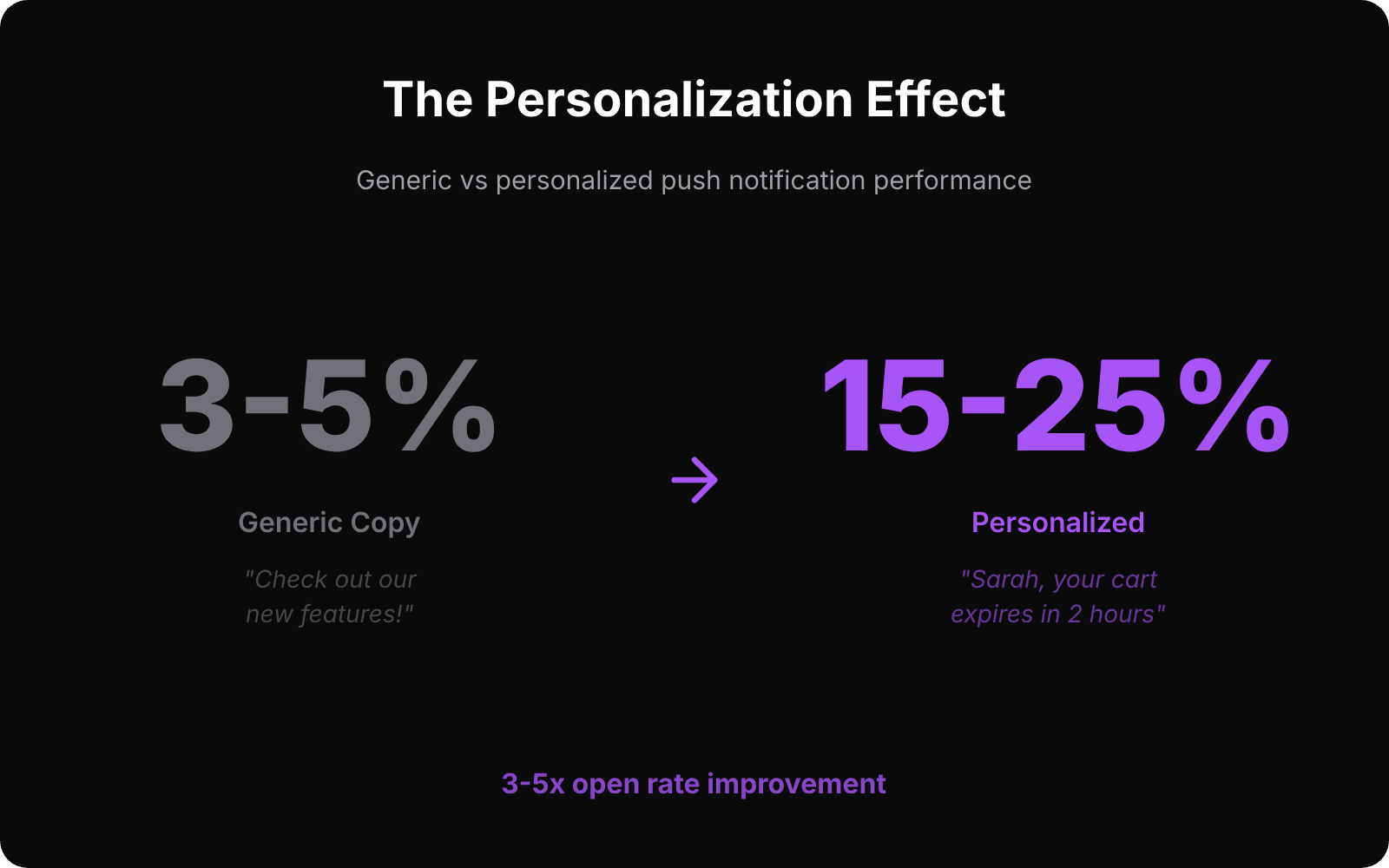
The anti-pattern:Every notification reads like it was written for nobody in particular. “Check out our new features!” “Don't miss our latest deals!” “We have exciting updates!”
Why it kills engagement:These messages could come from any app. They contain no information specific to the user, their behavior, or their interests. They're noise in a notification shade already full of noise.
The fix: Use parameters to make messages personal. Reference the user's name, their last action, the specific item they left in their cart, or their progress toward a goal. A message that says “Hey Sarah, your cart with the blue sneakers is expiring today” outperforms “Don't forget your cart!” by 3–5x in open rates.
6. No Message Rotation
The anti-pattern:A recurring campaign sends the exact same message every time. The user sees “We miss you! Come back!” on Day 3, Day 10, Day 17, Day 24… same title, same body, same everything.
Why it kills engagement:After the second identical notification, the user's brain classifies it as repetitive noise. Open rates for the third and subsequent sends of the same message drop dramatically. It stops registering as new information.
The fix:Create 3–5 message variants per campaign. Each variant takes a different angle or offers different value. The system rotates through them sequentially, so the user never sees the same message twice in a row. Fresh content keeps the notification feeling new even on the fifth send.
7. No Measurement, No Iteration
The anti-pattern:Set up campaigns, launch them, never look at the analytics again. Push becomes a “set it and forget it” system with no feedback loop.
Why it kills engagement:Without measurement, you don't know which campaigns are working and which are actively driving users away. A campaign with a 1% open rate and a high opt-out rate is worse than no campaign at all.
The fix: Review campaign performance weekly. Track per-campaign open rates, delivery rates, and opt-out rates. Kill campaigns that underperform. Double down on patterns that work. Use health scores to quickly identify campaigns that need attention. A/B test message variants over time to continuously improve.
The Common Thread
All seven anti-patterns share the same root cause: treating push notifications as a broadcast channel instead of a personal communication channel.
Push isn't email. It isn't social media. It's the most direct line to your user's attention. Every notification you send is a withdrawal from a limited trust account. Make each one count.
The fix for every anti-pattern boils down to the same principles: target based on behavior, personalize the content, respect the user's time and attention, and measure everything. Apps that follow these principles don't just avoid the pitfalls — they turn push into their highest-ROI engagement channel.
Ready to send smarter push notifications?
Build smarter engagement with SmartAppPush.
Get Started Free