How to Calculate Push Notification ROI for Your Mobile App

Most teams know push notifications “help with engagement,” but few can put a number on it. Without measurable ROI, push becomes an afterthought — something you set up once and forget about. This article gives you a framework to measure what push is actually worth to your business.
The Four Metrics That Matter
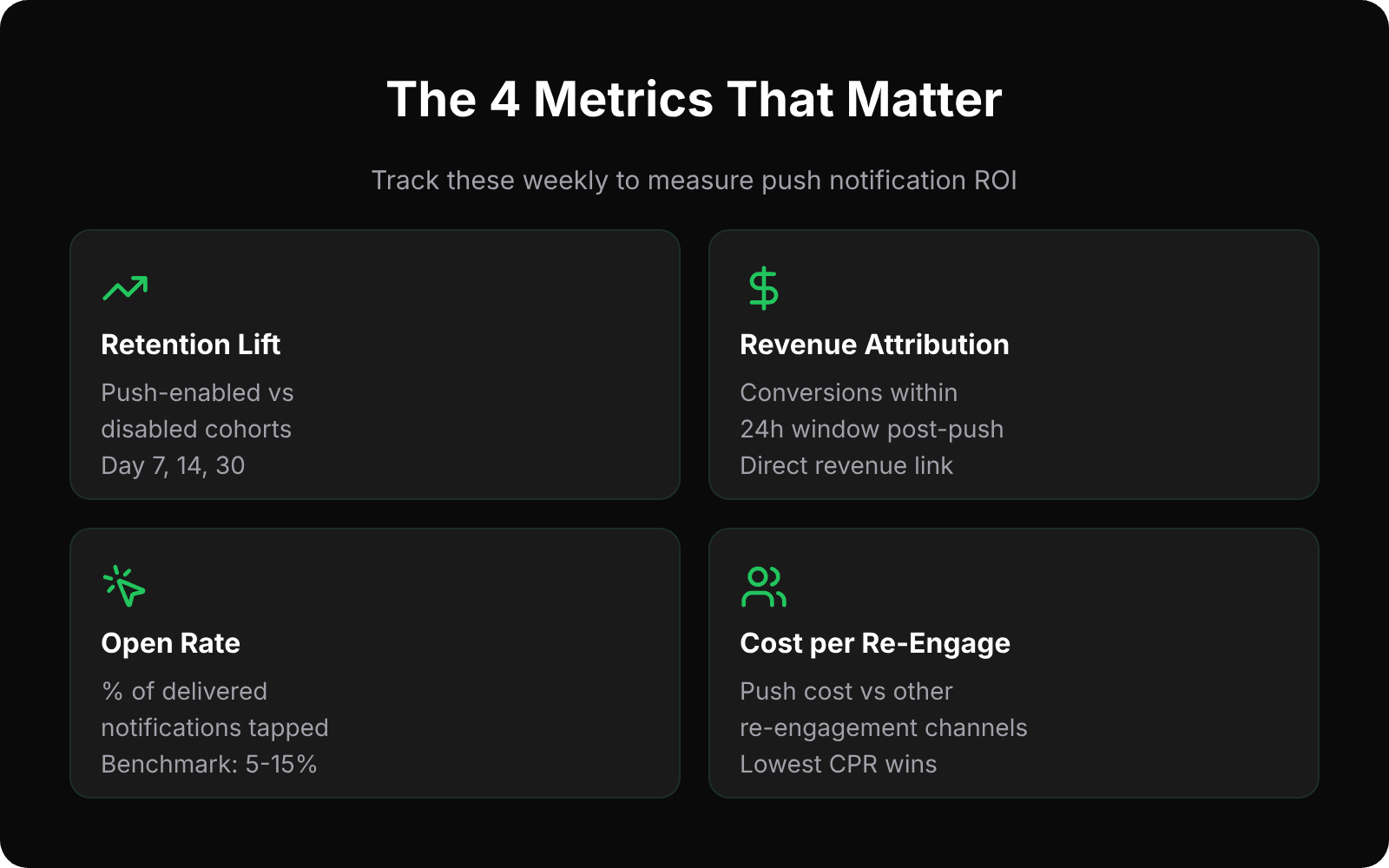
Push notification ROI isn't a single number. It's a combination of four metrics that together paint the full picture:
1. Retention Lift
The most valuable thing push notifications do is bring users back. Measure this by comparing retention rates between push-reachable users (push enabled) and push-unreachable users (push disabled).
How to calculate: Take your Day 7, Day 14, and Day 30 retention rates. Split them by push-enabled vs. push-disabled cohorts. The difference is your retention lift from push.
Example: If Day 7 retention is 28% for push-enabled users vs. 15% for push-disabled users, push is responsible for a 13 percentage point lift — nearly doubling your retention.
2. Open Rate
Open rate measures how many delivered notifications users actually tap. It's the most direct measure of whether your push content is relevant.
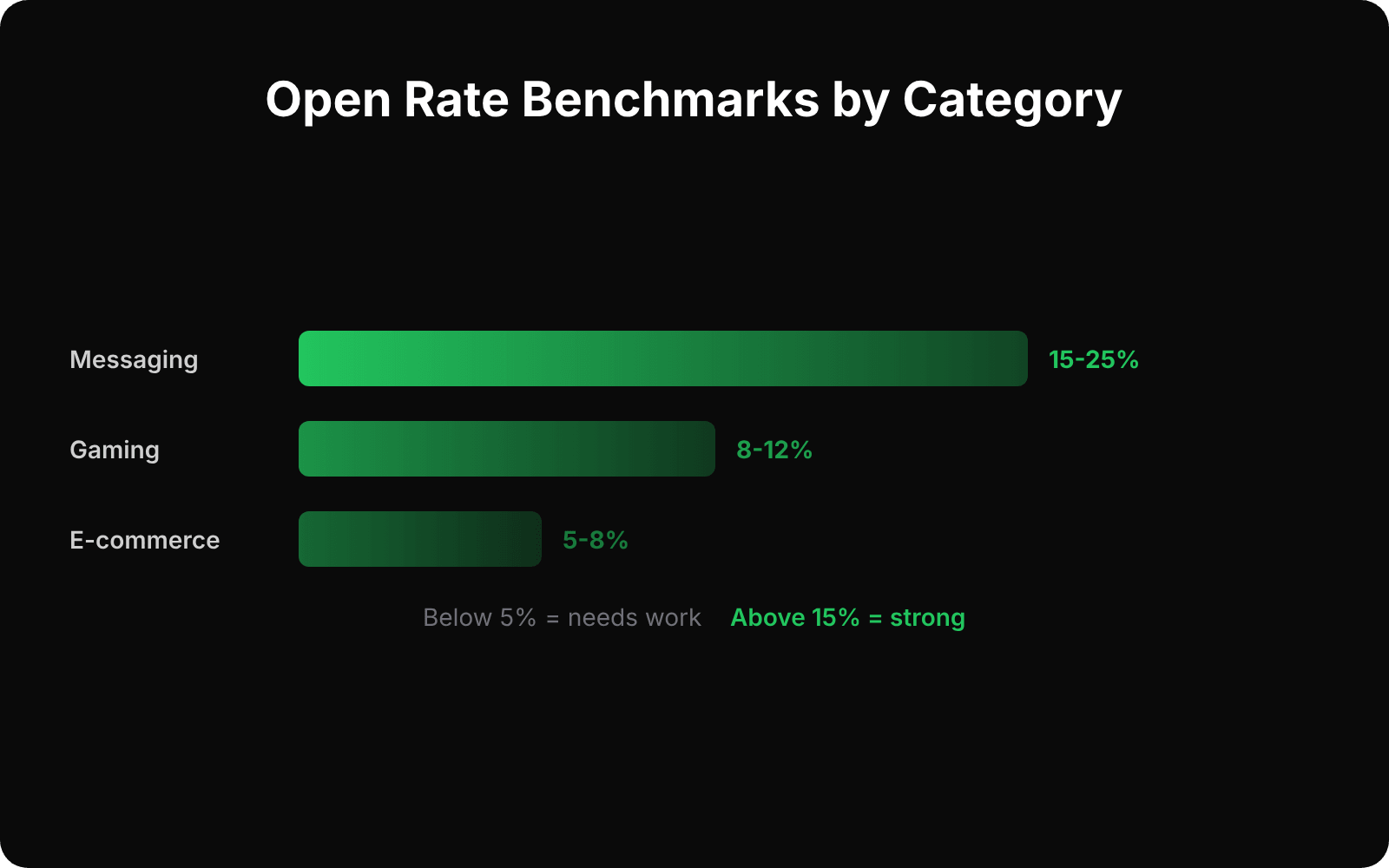
Benchmarks:Average push open rates range from 5–15%, depending on app category. E-commerce tends toward 5–8%, messaging apps toward 15–25%, gaming around 8–12%. If you're below 5%, your content or targeting needs work. Above 15%, you're doing something right.
3. Revenue Attribution
For apps with monetization (e-commerce, subscriptions, in-app purchases), you can directly attribute revenue to push notifications by tracking conversions within a time window after a push open.
How to calculate: When a user opens a push and then completes a purchase within 24 hours, attribute that revenue to the push campaign. Sum attributed revenue across all campaigns for a given period.
Example: A cart abandonment push campaign recovers 15% of abandoned carts. Average cart value is $45. With 1,000 abandoned carts per month, that's 150 recovered carts × $45 = $6,750/month in recovered revenue from a single campaign.
4. Cost Per Re-Engaged User
Compare the cost of re-engaging a user through push vs. other channels: paid ads, email, in-app messaging. Push is almost always the cheapest channel because the delivery cost is near-zero (you're using infrastructure you already pay for).
How to calculate:Total monthly push platform cost ÷ number of users who returned to the app via push. Compare this to your cost-per-click from paid re-engagement campaigns.
Building Your ROI Dashboard
A practical push ROI dashboard tracks these metrics weekly:
- Push-enabled rate — What percentage of your users can receive push? This is your ceiling. If it's below 50%, focus on permission optimization before campaign optimization.
- Delivery rate — Of pushes sent, how many were successfully delivered? Low delivery rates indicate stale device tokens or provider issues.
- Open rate per campaign — Which campaigns are users engaging with? This tells you what content resonates.
- Retention lift — Is push actually bringing users back? This is the ultimate measure of push value.
- Revenue per push — For monetized apps, what's the average revenue generated per push notification sent?
Common ROI Calculation Mistakes
- Counting all post-push actions as attributed. A user who opens a push and then purchases 3 weeks later probably wasn't influenced by the push. Use a 24–48 hour attribution window.
- Ignoring the opt-out cost. If a campaign drives purchases but also drives opt-outs, the net ROI may be negative. Every user who disables push has a lifetime value cost.
- Comparing push to no-push. The real comparison is push vs. alternative re-engagement channels. Push may look expensive compared to “free,” but it's cheap compared to paid ads.
- Not segmenting by campaign type. Your welcome series might have 30% open rates while your weekly digest has 3%. Averaging them hides the insight. Measure each campaign individually.
A Quick Formula
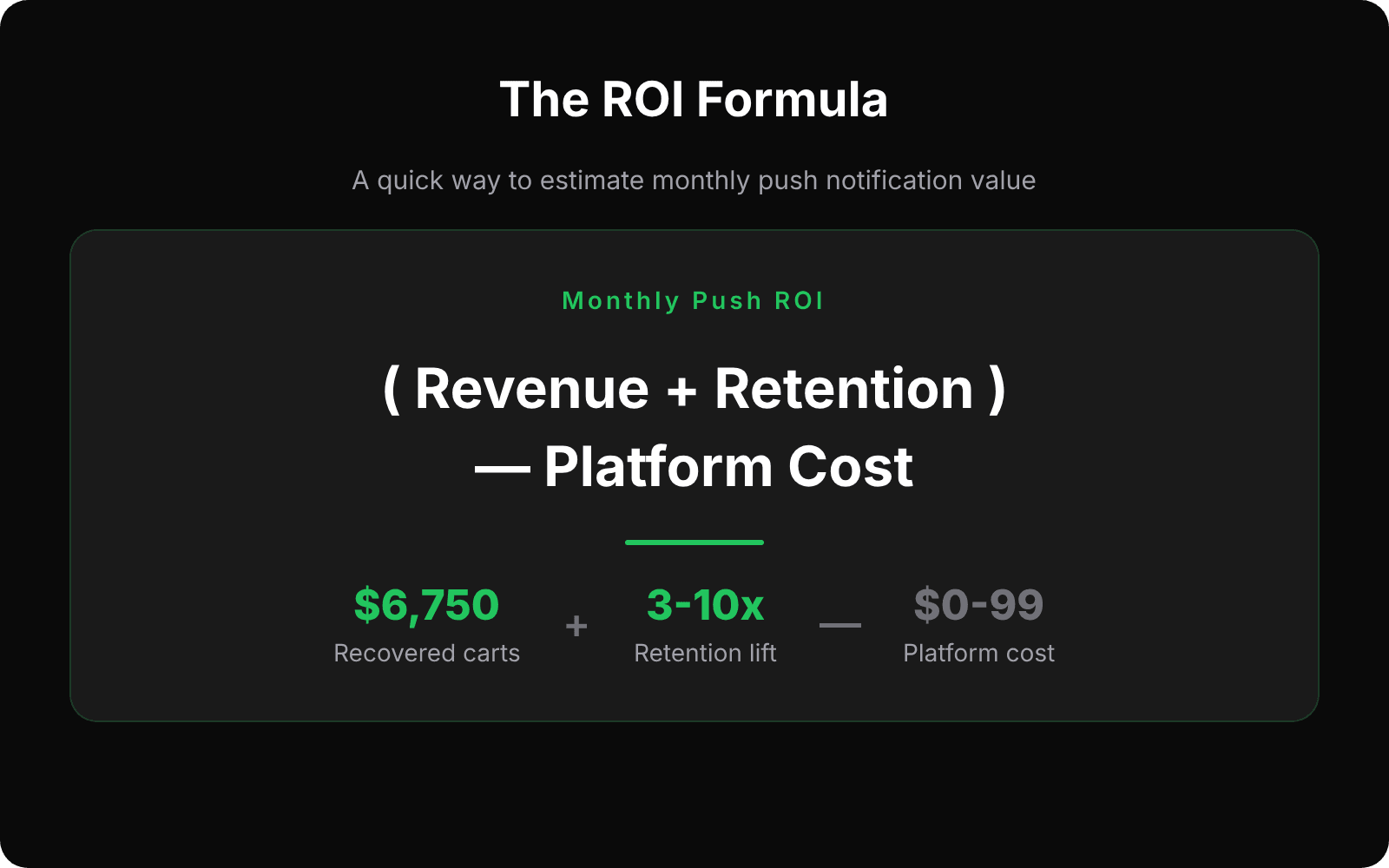
For a rough push ROI estimate, use this simplified formula:
Monthly Push ROI= (Attributed Revenue + Retention Value) − Platform Cost
Where Retention Value= (Additional retained users from push × Average Revenue Per User per month). This gives you a monthly dollar value for your push notification investment.
Start Measuring
You can't improve what you don't measure. Most push platforms provide delivery and open rate data out of the box. The missing piece for most teams is the attribution layer — connecting push opens to downstream actions like purchases, signups, and continued engagement.
Start with open rates and retention lift. Add revenue attribution when you have the data pipeline. Within a month, you'll have a clear picture of whether push is a cost center or a profit center— and in almost every case, the answer is the latter.
Ready to send smarter push notifications?
Build smarter engagement with SmartAppPush.
Get Started Free